How Statistical Tools Refine Bookmaker Margins Amid Britain's Sports Betting Boom
Written by Zoe Meier · Jun 2, 2026

How Statistical Tools Refine Bookmaker Margins Amid Britain's Sports Betting Boom
Britain's sports wagering sector continues to expand through 2026, and operators rely on layered statistical frameworks to set margins that balance competitiveness with profitability; these systems draw from probability theory and historical datasets to adjust odds across football, tennis, and other popular markets. Data from industry reports shows that bookmakers incorporate models such as Poisson distributions for goal scoring projections while layering in real-time variables like player injuries and weather conditions, and this approach allows margins to tighten or widen depending on betting volume patterns observed during major events.
Core Models Behind Margin Setting
Operators apply the overround principle as a foundational calculation where the sum of implied probabilities exceeds 100 percent, and researchers at institutions including the University of Nevada have documented how this creates the house edge across multiple outcomes; extensions of this method now integrate logistic regression to predict win probabilities more accurately when new information arrives mid-event. Observers note that Monte Carlo simulations run thousands of iterations on past match data to generate confidence intervals around expected margins, which helps firms respond to sharp money movements without overexposing themselves on any single line.
Bayesian updating plays a growing role because it lets algorithms revise prior distributions as fresh data streams in from live feeds, and this produces dynamic margin adjustments that reflect shifting public sentiment alongside objective performance metrics. Those who have examined operator filings find that variance reduction techniques such as Kelly criterion derivatives guide stake acceptance thresholds so that large wagers on low-margin bets do not erode overall profitability.
Integration of Real-Time Data Streams
By June 2026, many platforms had scaled cloud-based pipelines that ingest event data at sub-second intervals, feeding into ensemble models that combine gradient boosting with neural networks to forecast margin erosion risks. Studies from the Journal of Gambling Studies indicate that firms using these hybrid systems achieve tighter control over their theoretical hold percentages even as customer volumes spike around Premier League weekends and international tournaments. External factors such as regulatory changes in adjacent markets also enter the frameworks through scenario analysis modules that simulate margin impacts under different tax or licensing regimes.
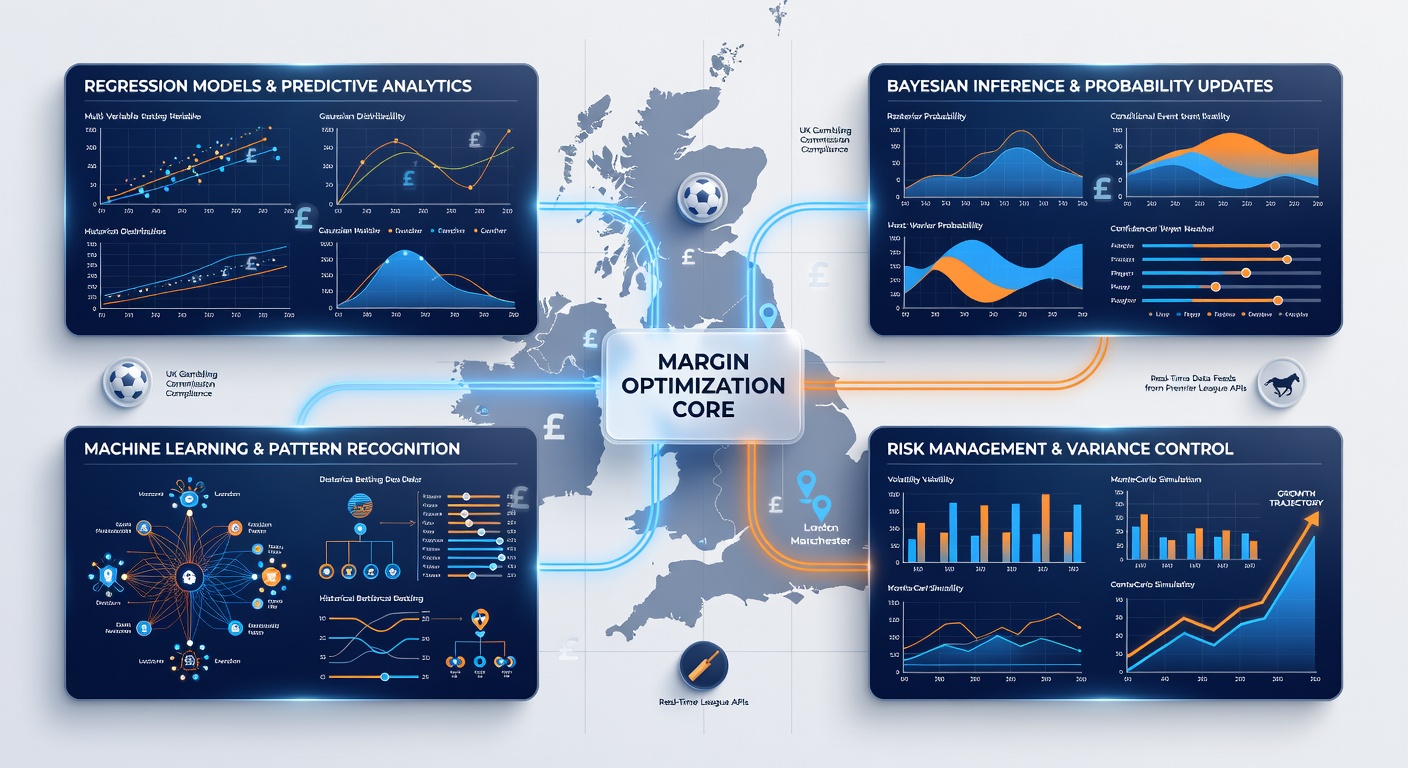
What's interesting is how correlation matrices now account for cross-sport and in-play dependencies, since a heavy volume of correlated bets on related outcomes can amplify risk beyond simple additive models; operators therefore apply copula functions to capture tail dependencies that standard variance calculations miss. Evidence suggests these refinements help maintain stable margins despite the proliferation of micro-markets that fragment betting action into smaller slices.
Case Examples from Market Participants
One major operator adjusted its tennis margin model after incorporating serve percentage volatility data from multiple surfaces, and the result was a measurable reduction in exposure during Grand Slam events where surface-specific edges had previously gone undetected. Another firm applied survival analysis to injury recovery timelines, allowing its algorithms to shift margins on player prop bets in advance of public information releases. According to findings published by the Journal of Gambling Studies, such targeted statistical interventions correlate with improved risk-adjusted returns across large betting books.
Take the example of a research team that tracked margin compression in football markets over a full season, and they discovered that incorporating expected goals metrics reduced overround leakage by several basis points when compared with traditional shot-based models; this kind of incremental gain compounds across thousands of daily markets. The same team later extended the framework to rugby and cricket, where ball-by-ball data creates even denser information environments for real-time recalibration.
Challenges and Ongoing Refinements
High-frequency betting activity tests the limits of even sophisticated models because latency between data arrival and odds publication can create temporary arbitrage windows, and operators counter this through distributed computing clusters that parallelize simulation workloads. Reports from the Australian Institute of Family Studies on international wagering trends highlight how firms that invest in robust statistical governance frameworks experience fewer margin breaches during periods of elevated volatility. Those frameworks also incorporate stress-testing protocols that replay historical black-swan events to verify margin resilience under extreme scenarios.
Yet model drift remains a persistent concern as player tactics and league rules evolve, prompting regular recalibration cycles that blend fresh empirical data with expert judgment on structural breaks. Observers note that the most successful operators treat margin optimization as an iterative process rather than a static formula, updating priors and feature weights on weekly or even daily schedules depending on sport and market liquidity.
Conclusion
Statistical frameworks continue to underpin margin optimization strategies throughout Britain's expanding sports wagering sector, with operators deploying increasingly granular models that integrate historical patterns, live feeds, and risk correlations to sustain balanced books. As data sources multiply and computational power grows, these systems are expected to incorporate additional layers such as graph neural networks for relationship mapping across player and team statistics. The result is a continuously evolving analytical landscape where precision in probability estimation directly translates into operational stability across diverse betting products and seasonal cycles.